Japan’s autumn color season lasts longer than cherry blossom season and moves south over two and a half months. Pick your dates and you can almost always find leaves at their best somewhere on your route.
This post contains affiliate links. We may earn a commission if you book through them. How we make money.
Quick answer
Koyo, the autumn leaves, start in Hokkaido’s mountains in late September and reach Tokyo and Kyoto in the second half of November, often lasting into early December. For a classic Tokyo and Kyoto trip, aim for roughly November 15 to December 5. For mountain scenery in Nikko, northern Japan or the Japanese Alps, go in mid to late October.
When the leaves turn, by region
Leaves change color as night temperatures drop below about 8°C, so the season starts in the north and on mountaintops, then moves south and down into the cities. Unlike cherry blossoms, which last a week, autumn colors stay good for two to three weeks in any one place.
| Region | Typical peak | Good places |
|---|---|---|
| Hokkaido mountains | Late September – early October | Daisetsuzan, Shiretoko |
| Hokkaido lowlands | Mid – late October | Jozankei, Sapporo, Hakodate |
| Tohoku (north Honshu) | Mid October – early November | Oirase Gorge, Hachimantai, Naruko Gorge |
| Nikko and Japanese Alps | Early October (high) – early November (town) | Irohazaka, Lake Chuzenji, Kamikochi, Kurobe |
| Fuji Five Lakes and Hakone | Early – late November | Lake Kawaguchiko, Owakudani |
| Tokyo | Mid November – early December | Rikugien, Jingu Gaien ginkgo avenue, Mt Takao |
| Kyoto, Nara, Osaka | Mid November – early December | Tofuku-ji, Eikan-do, Arashiyama, Nara Park |
| Hiroshima and Kyushu | Mid November – early December | Miyajima’s Momijidani, Yabakei |
These are averages. Warm autumns, which have become more common, can push the peak in Tokyo and Kyoto into the first week of December. The Japan Weather Association and Weathernews publish koyo forecasts from September, updated weekly; check them before you lock in hotel dates.
Best spots in Kyoto
Kyoto is the most famous autumn destination in Japan, and for good reason: maple trees around wooden temples, moss gardens and stone paths. It is also very crowded in the last two weeks of November.
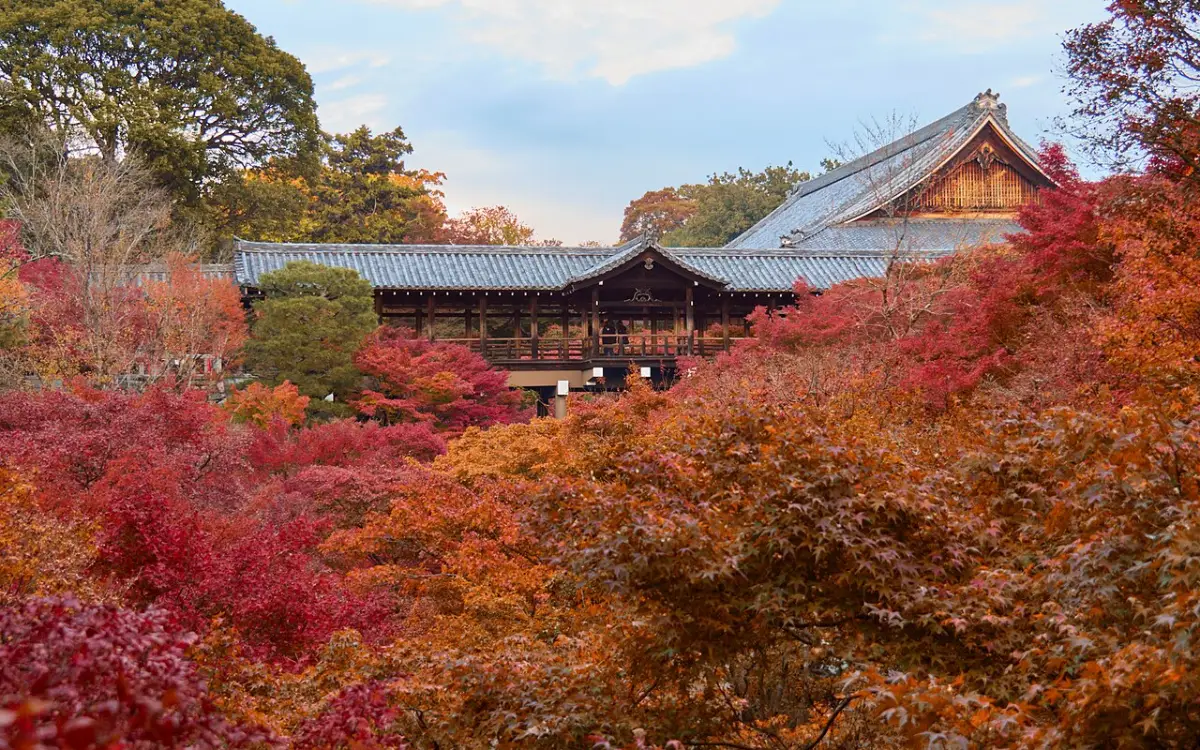
- Tofuku-ji: the Tsutenkyo bridge looks over a valley of around 2,000 maples. It is the most photographed view in Kyoto in autumn. Arrive at opening time.
- Eikan-do: a hillside temple known as the best place in Kyoto for maples, with evening illuminations during the season.
- Kiyomizu-dera: the wooden stage over a sea of red maples, with special night openings in autumn.
- Arashiyama: the hills behind the Togetsukyo Bridge, Tenryu-ji’s garden and quieter Jojakko-ji and Gio-ji with their moss gardens.
- Northern Kyoto: Kurama, Kibune and Ohara turn a week or so earlier than the city center and are far less crowded.
Visiting Kyoto in November?
Hotels in late November sell out early. Our area guide shows where to stay.
Best spots in and near Tokyo
- Jingu Gaien Icho Namiki: an avenue of tall ginkgo trees that turn bright yellow, usually around the last week of November.
- Rikugien and Koishikawa Korakuen: two of the city’s most beautiful Edo-period gardens, with evening light-ups at Rikugien.
- Shinjuku Gyoen: big lawns, maples and a mix of Japanese, English and French garden styles.
- Mt Takao: an easy hike under an hour from Shinjuku. Go on a weekday, as weekends in November are packed.
- Showa Kinen Park: a huge park in western Tokyo with a famous ginkgo avenue and a Japanese garden.
Beyond the big cities
Nikko is two hours from Tokyo and offers the most dramatic mountain koyo within day-trip range. The Irohazaka switchback road and Lake Chuzenji peak in mid to late October, and the shrine area in town follows in early November. See our Nikko day trip guide.
Lake Kawaguchiko, at the foot of Mt Fuji, has the Momiji Corridor, a tunnel of maples by the lake, lit up in the evenings during its autumn festival in early to mid November. Clear autumn air also gives you one of the best chances of seeing Fuji itself.
Hakone pairs autumn color with hot springs. The ropeway over Owakudani and the garden of the Hakone Museum of Art are highlights.
Oirase Gorge in Aomori is a 14-kilometer riverside trail of waterfalls and beech forest that peaks in late October. Combine it with Lake Towada for a few days in the north.
Korankei, near Nagoya, has around 4,000 maples along a river and an evening light-up in November. It is an easy stop if you are going between Tokyo and Kyoto.
How to plan a koyo trip
The beauty of autumn is that you can follow the color. Two examples:
- Late October: start in Tokyo, spend two nights in Nikko, then head north to Aomori and Oirase Gorge. The mountains will be at or near peak and the cities still green.
- Late November: Tokyo, a night at Lake Kawaguchiko, then four or five nights in Kyoto with a day in Nara. This is the classic route at its most colorful.
Book early. Kyoto hotels for the third and fourth weeks of November are some of the hardest rooms in Japan to find, and prices can be 30 to 50 percent above normal. If Kyoto is full, staying in Osaka and taking the 15-minute Shinkansen or 30-minute train is a good fallback.
Planning an autumn trip?
Compare hotels in Kyoto, Tokyo and Kawaguchiko for November dates.
Tips for beating the crowds
- Go early. Most temples open at 8 or 9 am. The first hour is calm; by 10 am the famous ones are packed.
- Avoid weekends and Labor Thanksgiving Day (November 23), when Japanese visitors join the crowds.
- Use night illuminations. Many temples open after dark with lit-up maples. They are busy, but the atmosphere is worth it.
- Pick lesser-known temples. In Kyoto, Shinnyo-do, Genko-an and the temples of Ohara are just as colorful as the big names.
- Pack layers. Days in late November are mild, around 12 to 17°C in Tokyo and Kyoto, but evenings get cold, especially at night light-ups and in the mountains.
Autumn is quietly one of the best times to visit Japan: comfortable temperatures, clear skies, fewer typhoons than in September and seasonal food such as chestnuts, persimmons and matsutake mushrooms. If you missed the cherry blossoms, the maples are an excellent consolation.
Photo: Tofuku-ji by lumoplank, CC0, via Wikimedia Commons.
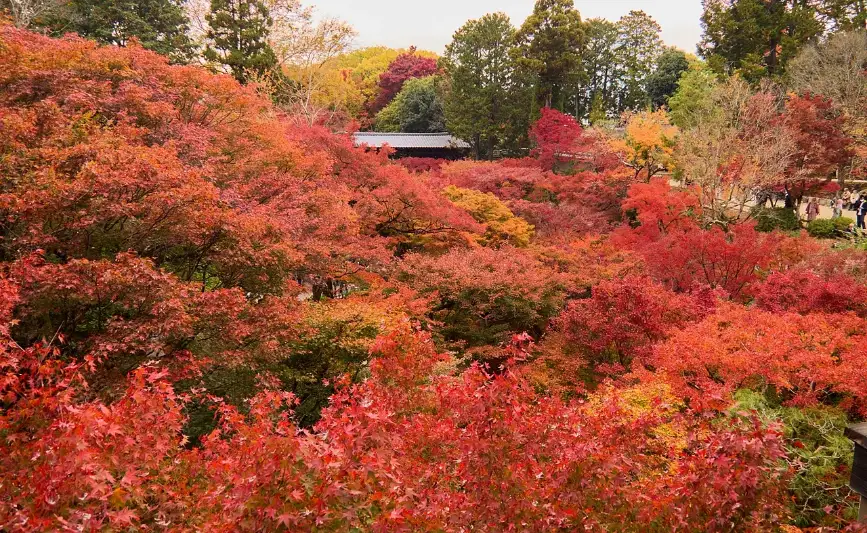
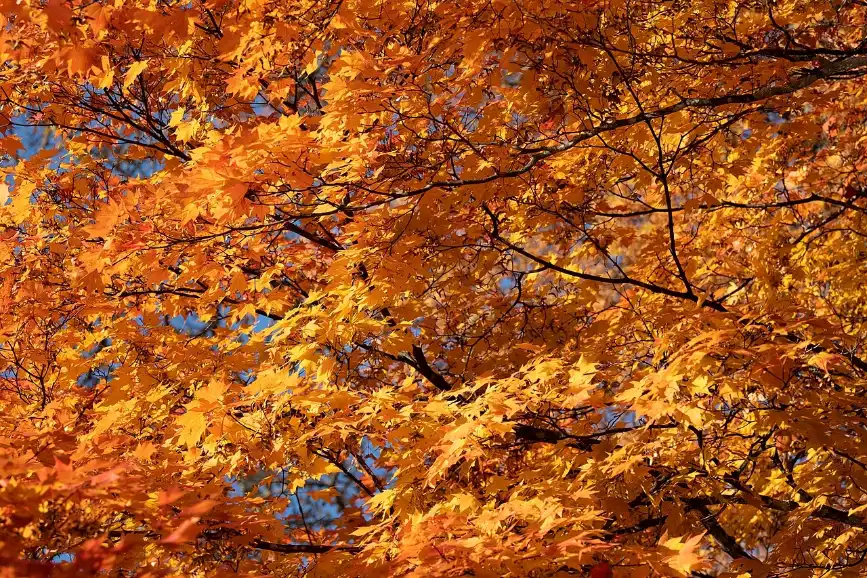
More photos: Tofuku-ji, Kyoto – Tofukuji6625 by lumoplank, CC0; Nikko autumn leaves by Raita Futo, CC BY 2.0. Via Wikimedia Commons.